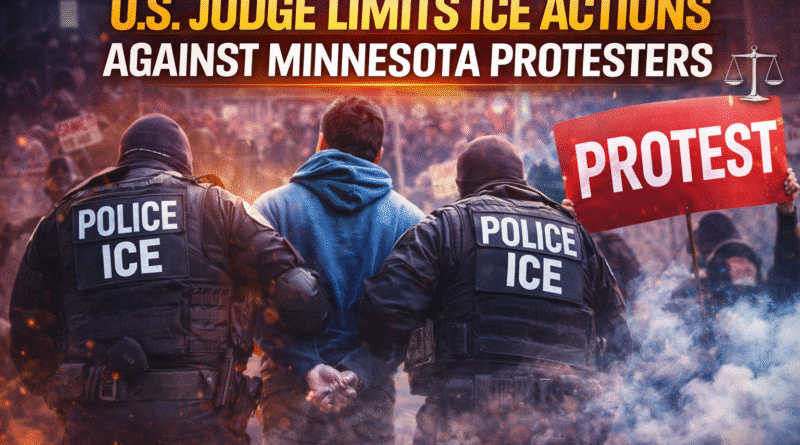
US Judge Orders Limits on ICE Actions Against Minnesota Protesters
Meta Title
US Judge Restricts ICE Actions Against Minnesota Protesters After Deadly Clashes
Meta Description
A federal judge in Minnesota has ordered limits on ICE tactics, banning arrests, retaliation, and crowd-control weapons against peaceful protesters following deadly unrest.
Focus Keywords
ICE protests Minnesota, US judge ICE injunction, Minnesota immigration protests, Trump Insurrection Act, ICE agents protesters rights
Introduction: A Court Steps In Amid Escalating Tensions
A federal judge in Minnesota has issued a sweeping injunction restricting how Immigration and Customs Enforcement (ICE) agents may operate against protesters and observers, following weeks of escalating unrest and a fatal shooting involving a federal officer.
The ruling marks a significant legal check on federal immigration enforcement tactics, as Minnesota becomes a flashpoint in the broader national debate over immigration, civil liberties, and presidential power under President Donald Trump’s administration.
What Prompted the Judge’s Order?
Deadly Incident Sparks Outrage
Tensions intensified earlier this month after an ICE agent fatally shot 37-year-old Renee Nicole Good, a mother of three, while she was sitting in her car. Good was participating in community patrols organized by local activists to monitor ICE operations in Minneapolis neighborhoods.
The shooting triggered widespread protests, nightly confrontations, and growing criticism from civil rights groups and local leaders.
The Federal Court Ruling Explained
What the Injunction Does
On Friday, US District Judge Kate Menendez ordered immediate limits on ICE agents’ actions in Minnesota. The injunction explicitly:
- Bans retaliation against peaceful protesters and observers
- Prohibits arrests or detention of individuals engaged in lawful, non-obstructive protest
- Prevents agents from acting without reasonable suspicion of a crime
- Bars the use of pepper spray, tear gas, and other crowd-control weapons against peaceful demonstrators or bystanders
- Protects the right to observe, record, and monitor immigration enforcement activities
The Department of Homeland Security (DHS) has been given 72 hours to bring its Minneapolis operation into full compliance.
Why the Ruling Is a Major Victory for Protesters
Protection of First Amendment Rights
Civil rights advocates hailed the ruling as a critical defense of constitutional freedoms, especially the First Amendment right to peaceful assembly and protest.
The court made clear that law enforcement frustration does not justify collective punishment, aggressive crowd control, or retaliatory arrests against individuals who are not interfering with police activity.
Scale of the ICE Operation in Minnesota
The Largest Deployment in US History
The injunction comes just weeks after the Trump administration announced the deployment of 2,000 ICE agents to Minnesota. That number has since grown to nearly 3,000 federal officers, vastly outnumbering local police forces.
DHS has described the effort as the largest immigration enforcement operation ever conducted in the United States.
Ongoing Clashes in Minneapolis
Protesters vs Federal Agents
Crowds of demonstrators across Minneapolis have repeatedly clashed with federal agents, opposing what they see as aggressive targeting of undocumented migrants.
Video footage and eyewitness accounts have shown officers using force, prompting lawsuits and emergency court intervention.
Trump’s Insurrection Act Threat
What the President Said
Amid the standoff between federal authorities and Minnesota leaders, President Trump raised the possibility of invoking the Insurrection Act, a rarely used law that allows deployment of US military forces for domestic law enforcement.
“If I needed it, I would use it,” Trump told reporters at the White House. “I don’t think there is any reason right now to use it.”
What Is the Insurrection Act?
A Powerful and Controversial Law
The Insurrection Act allows a president to bypass the Posse Comitatus Act, which normally bars the military from policing civilians.
Under the law, the president may deploy troops to suppress:
- Armed rebellion
- Domestic violence
- Situations deemed beyond the control of state authorities
Civil liberties groups warn that invoking the act would represent an extraordinary escalation with long-term consequences for democracy.
Political Fallout and Legal Ramifications
A Growing Legal Battle
The Minnesota ruling adds to a growing wave of lawsuits challenging ICE operations nationwide. Legal experts say the injunction could:
- Set precedent for future protest-related cases
- Strengthen protections for immigration observers
- Increase judicial scrutiny of federal enforcement tactics
The decision also intensifies pressure on the Trump administration as immigration enforcement becomes a defining issue ahead of the midterm elections.
DHS Response and What Comes Next
As of publication, DHS has not publicly commented on how it plans to modify its operations. Failure to comply with the injunction could result in contempt of court proceedings or further judicial intervention.
Activists say they will continue monitoring ICE activity closely, now backed by a clear court mandate.
Conclusion: A Defining Moment for Protest Rights
The Minnesota injunction represents a turning point in the clash between federal immigration enforcement and civil liberties. As protests continue and political rhetoric escalates, the ruling reinforces a key principle: peaceful dissent is not a crime.
Whether the administration complies fully—or seeks to challenge the order—could shape the future of protest rights and federal policing in America.