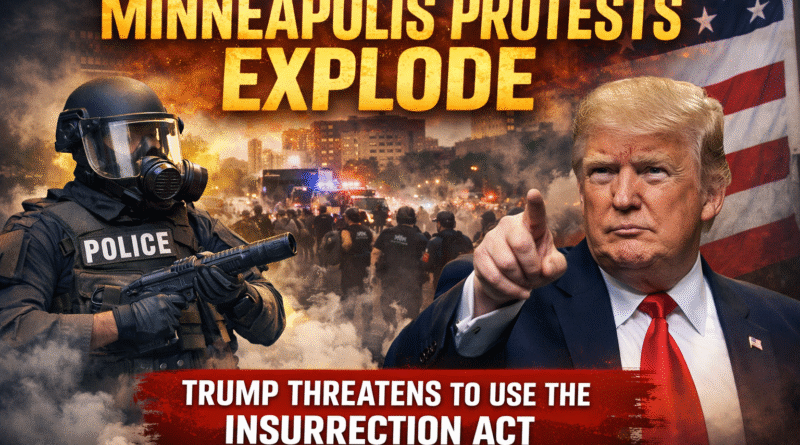
Protests Erupt Again in Minneapolis After Trump Threatens to Invoke the Insurrection Act
Meta Title
Minneapolis Protests Intensify as Trump Threatens Insurrection Act | Full Analysis
Meta Description
Protests flared again in Minneapolis after President Trump threatened to invoke the Insurrection Act following ICE-involved shootings. Read the full breakdown, legal implications, and national impact.
Focus Keywords
Minneapolis protests, Insurrection Act Trump, ICE shooting Minneapolis, federal immigration protests, Trump unrest response
Introduction: Minneapolis Faces Another Night of Unrest
Minneapolis once again became the center of national attention as protests erupted for another night following a second shooting involving a federal immigration officer in just one week. The unrest intensified after President Donald Trump warned that he may invoke the Insurrection Act, a rarely used and controversial federal law that allows the deployment of U.S. military troops on domestic soil.
As tensions rose outside the Bishop Henry Whipple Federal Building, demonstrators clashed with federal officers wearing tactical gear. The situation has sparked widespread debate across the United States, raising urgent questions about civil liberties, federal authority, immigration enforcement, and the limits of presidential power.
This article breaks down what happened, why it matters, and what it could mean for Minneapolis—and the nation—moving forward.
What Sparked the Latest Minneapolis Protests?
Second ICE-Involved Shooting in One Week
The latest wave of protests was triggered by the shooting of Julio Cesar Sosa-Celis, a Venezuelan national, by an ICE agent during an attempted arrest. According to federal officials, Sosa-Celis resisted arrest and allegedly assaulted the agent, prompting the officer to open fire.
The Department of Homeland Security stated that two other Venezuelan nationals were also detained after allegedly attacking the agent with a shovel and a broomstick. Officials confirmed that all three individuals were living in the United States illegally.
This incident followed another fatal shooting just over a week earlier involving 37-year-old Renee Good, who was shot and killed by an ICE agent. That case continues to fuel outrage, grief, and demands for accountability.
Protests Turn Heated Outside Federal Building
Clashes With Law Enforcement
On Thursday night, tensions escalated outside the Bishop Henry Whipple Federal Building in downtown Minneapolis. Protesters gathered to voice anger over immigration enforcement practices and the use of force by federal agents.
Federal officers responded by deploying tear gas and percussion grenades to disperse crowds. Video footage and eyewitness reports showed chaotic scenes as demonstrators shouted, threw objects, and attempted to block vehicles exiting the facility.
Loudspeaker warnings were issued, urging protesters to stop blocking the building’s driveway. Despite this, clashes continued, and several protesters were taken into custody, according to U.S. Customs and Border Protection officials.
Trump’s Insurrection Act Threat Explained
What Is the Insurrection Act?
The Insurrection Act, enacted in 1807, gives the president authority to deploy active-duty military forces within the United States to suppress civil disorder, insurrection, or rebellion when state authorities are unable or unwilling to do so.
While legal, the act is considered a last-resort measure due to its serious implications for democracy and civil rights.
Trump’s Warning Sends Shockwaves
President Trump warned that he could invoke the Insurrection Act to restore order in Minnesota. White House Press Secretary Karoline Leavitt stated that the act is a “tool at the president’s disposal” and said Trump’s comments were intended to send a strong message nationwide.
This is not the first time Trump has raised the idea. He previously threatened to invoke the act during:
- Anti-ICE protests in Portland
- Nationwide protests following the killing of George Floyd in 2020
However, actually invoking the act remains a highly controversial step that could significantly escalate tensions.
Legal and Civil Rights Concerns Mount
ACLU Pushes Back Strongly
The organization filed a class-action lawsuit against the federal government, alleging that immigration agents violated the Fourth Amendment rights of U.S. citizens during enforcement actions.
Legal experts warn that deploying military forces domestically could blur the line between law enforcement and military authority, potentially undermining constitutional protections.
Renee Good Case: A Tragedy Still Under Scrutiny
Family Demands Evidence Preservation
More than a week after Renee Good’s fatal shooting, her family’s legal team is demanding that all evidence be preserved. This includes:
- Her vehicle
- Cellphone video
- Dashcam footage
- Communications between federal agents
Attorneys suggest the civil investigation could lead to a major lawsuit against the federal government.
Incident reports and 911 transcripts released by Minneapolis officials reveal new details about the chaotic moments following the shooting, including information about multiple gunshot wounds.
Twin Cities on High Alert
Schools and Communities Feel the Impact
The unrest has extended beyond downtown Minneapolis. In nearby St. Paul, federal agents stopped two vans carrying students and school staff in separate incidents this week.
As a precaution, Saint Paul Public Schools announced that starting next week, students who feel unsafe attending school in person may opt for virtual learning.
Community leaders fear that aggressive enforcement actions could deepen fear and distrust, particularly among immigrant families.
State vs Federal Power: A Growing Legal Battle
The 10th Amendment Lawsuits
Minnesota and Illinois have invoked the 10th Amendment in lawsuits seeking to block federal agents from conducting certain operations within their cities.
The 10th Amendment reserves powers not delegated to the federal government to the states, setting the stage for a constitutional showdown over immigration enforcement and states’ rights.
This legal conflict could have nationwide implications, especially as other states closely watch the outcome.
Why the Insurrection Act Would Be a Huge Risk
Political and Social Fallout
Legal scholars and political analysts warn that invoking the Insurrection Act could:
- Intensify protests rather than calm them
- Erode trust in federal institutions
- Set a dangerous precedent for future administrations
Even critics who support stronger immigration enforcement argue that military deployment against civilians could damage America’s democratic norms.
Public Reaction Across the United States
A Nation Divided
Public opinion remains sharply divided. Supporters of Trump argue that restoring order is necessary and blame local leaders for failing to control unrest.
Opponents see the threat as authoritarian and fear it could criminalize peaceful protest.
Social media platforms are flooded with debate, videos from protests, and calls for accountability from both sides.
What Happens Next?
Key Questions Moving Forward
Several critical questions remain unanswered:
- Will Trump actually invoke the Insurrection Act?
- How will courts respond to state lawsuits?
- Will further ICE operations intensify unrest?
- Can community leaders de-escalate tensions?
The situation in Minneapolis remains fluid, with both legal and political consequences unfolding rapidly.
Conclusion: Minneapolis at a Crossroads
The renewed protests in Minneapolis highlight deep-rooted tensions surrounding immigration enforcement, federal authority, and civil rights in the United States.
As President Trump raises the possibility of invoking a centuries-old law, the nation watches closely. What happens next could shape not only Minneapolis’ future but also how America balances security, freedom, and democracy in moments of crisis.