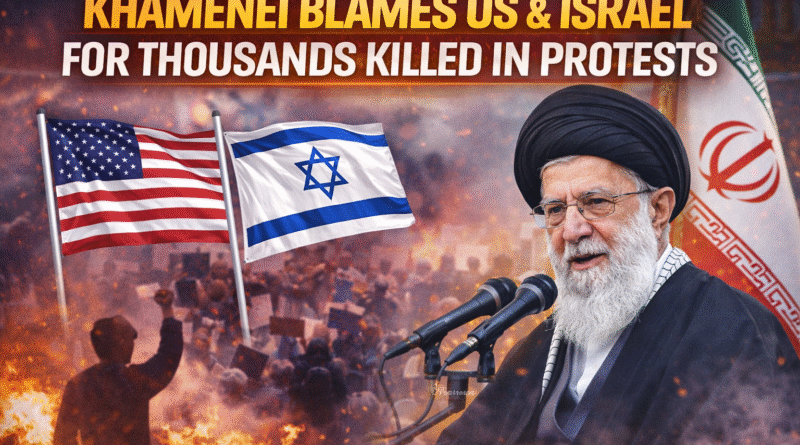
Iran’s Supreme Leader Claims US and Israel Linked to Thousands of Deaths in Protests
Meta Title
Iran’s Khamenei Blames US and Israel for Thousands Killed in Protests
Meta Description
Iran’s Supreme Leader Ayatollah Ali Khamenei claims US and Israeli involvement led to thousands of deaths during recent antigovernment protests, escalating regional tensions.
Focus Keywords
Iran protests 2026, Khamenei US Israel accusations, Iran unrest death toll, US Iran tensions, Middle East protests news
Introduction: Tehran Escalates Blame Over Deadly Unrest
Iran’s Supreme Leader Ayatollah Ali Khamenei has accused the United States and Israel of direct involvement in weeks of deadly antigovernment protests, claiming that foreign-backed unrest resulted in the deaths of “several thousand” people.
The remarks, delivered during a meeting with students in Tehran, represent the strongest and most explicit accusation yet from Iran’s highest authority, significantly escalating tensions with Washington and Tel Aviv.
Khamenei’s Claims: Foreign Powers Behind the Violence
“Massive Damage and Thousands Killed”
According to Iranian state media, Khamenei said actors linked to the US and Israel orchestrated violent actions during the protests, leading to widespread destruction and a death toll far higher than previously acknowledged by Iranian officials.
“Those linked to Israel and the United States caused massive damage and killed several thousands,” Khamenei said.
He described US President Donald Trump as a “criminal,” alleging that this round of unrest differed from past protests because of direct presidential involvement from Washington.
A Shift in Iran’s Official Narrative
From Hundreds to Thousands
Khamenei’s comments mark the first time Iran’s leadership has publicly suggested that protest-related deaths reached into the thousands.
Until now, Iranian officials had acknowledged hundreds of deaths, including members of the security forces. However, some international human rights groups, including US-based organizations, have claimed casualty figures closer to 3,000 or more.
Al Jazeera correspondent Resul Serdar Atas noted that this shift represents a major rhetorical escalation.
“For the first time, he is actually giving a sense of the numbers of people killed,” Atas said.
Iran Accuses US and Israel of Direct Coordination
“A Central Figure in the Plot”
Khamenei alleged a deeper level of US involvement than in previous unrest, claiming President Trump played a central role in what he described as an international conspiracy to destabilize Iran.
Iranian authorities have long blamed foreign adversaries for domestic unrest, but the explicit accusation against the sitting US president marks a sharp escalation.
Arrests, Damage, and Government Crackdown
Thousands Detained, Infrastructure Damaged
Iranian officials say:
- Around 3,000 people have been arrested
- More than 250 mosques and medical facilities were damaged or burned
- Protests spread across multiple cities over more than two weeks
Authorities claim demonstrations were initially peaceful, driven by rising prices and economic hardship, before being “hijacked” by violent actors allegedly supported by foreign powers.
Competing Death Toll Estimates
No Independent Verification
There is no independently confirmed death toll. While Iranian officials blame violent protesters for many deaths, international rights groups accuse security forces of using excessive force.
Human rights organizations argue that the true number of fatalities is likely far higher than what has been publicly disclosed.
Iran’s Warning to Its Rivals
“Criminals Will Not Go Unpunished”
Despite the sharp rhetoric, Khamenei said Iran would avoid dragging the country into open war. However, he warned that those deemed responsible—domestic or international—would face consequences.
“We will not drag the country into war, but we will not let criminals go unpunished,” he said.
Internet Blackouts and Media Control
Gradual Restoration of Services
As protests subsided, Iranian authorities began restoring limited communications. The semi-official Fars News Agency reported that SMS services were restored nationwide following eight days of near-total internet disruption.
Digital blackouts have become a recurring tactic during periods of unrest in Iran, drawing criticism from rights groups and foreign governments.
Why This Matters Globally
Rising US–Iran Tensions
Khamenei’s accusations come at a time of heightened strain between Iran and the West, with disputes over:
- Nuclear policy
- Regional influence
- Sanctions
- Israel’s security
Analysts warn that such rhetoric could further harden positions on both sides, increasing the risk of diplomatic breakdown or proxy conflict escalation.
Conclusion: A Dangerous Escalation in Rhetoric
Iran’s supreme leader has drawn a direct line between domestic unrest and foreign adversaries, placing the United States and Israel at the center of his narrative.
Whether the claims can be substantiated remains unclear. But by asserting a death toll in the thousands and accusing Washington of direct involvement, Tehran has raised the stakes—politically, diplomatically, and rhetorically—at a fragile moment for regional stability.