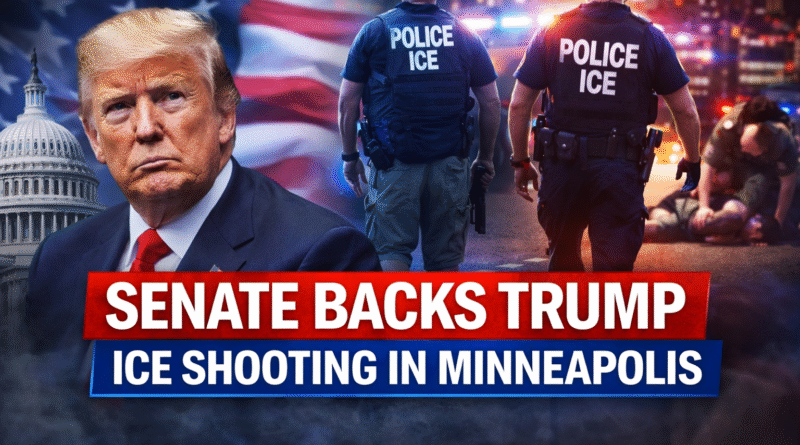
Senate Backs Trump on Venezuela Resolution as ICE Shooting Sparks National Debate
Focus Keyword:
Senate backs Trump Venezuela resolution
Secondary Keywords:
ICE shooting Minneapolis, Donald Trump interview Reuters, JD Vance tie breaking vote, US immigration enforcement, Minnesota ICE incident
URL Slug:
senate-backs-trump-venezuela-ice-shooting
Senate Backs Trump on Venezuela Resolution as ICE Shooting in Minneapolis Sparks National Outrage
The United States Senate has once again placed Donald Trump at the center of global and domestic controversy. In a dramatic vote, the Senate approved a resolution backing Trump’s hardline stance on Venezuela — a decision finalized by a tie-breaking vote cast by Vice President JD Vance.
At the same time, a shooting involving federal immigration officers in Minneapolis has intensified national debate over immigration enforcement, state resistance, and the use of force by ICE agents. Together, these events highlight deep political divisions in the US, spanning foreign policy, immigration, law enforcement, and executive power.
Senate Approves Venezuela Resolution With Vance’s Tie-Breaking Vote
In a closely divided chamber, the Senate deadlocked on a resolution supporting former president Donald Trump’s position on Venezuela. The resolution, viewed as a symbolic but politically powerful endorsement, passed only after Vice President JD Vance exercised his constitutional authority to break the tie.
Supporters of the resolution argue that Venezuela remains a destabilizing force in the Western Hemisphere and that firm US pressure is necessary to protect American interests and regional security. Critics, however, warn that Trump’s Venezuela policy risks escalating tensions and undermining diplomatic solutions.
The vote underscores how narrowly divided Washington remains — and how influential the vice presidency has become in shaping legislative outcomes.
Why Venezuela Remains a Flashpoint in US Politics
Venezuela has long been a contentious issue in US foreign policy. Economic collapse, political repression, and migration crises have made the South American nation a recurring concern for American lawmakers.
Trump’s approach emphasized:
- Economic sanctions
- Diplomatic isolation
- Support for opposition leadership
While some lawmakers credit these measures with increasing pressure on Venezuela’s leadership, others argue they worsened humanitarian conditions and drove migration toward the US border.
The Senate’s vote signals that Trump’s foreign policy legacy continues to influence Republican strategy, even amid changing global dynamics.
ICE Shooting in Minneapolis Raises Alarming Questions
As lawmakers debated international affairs, events on the ground in Minneapolis brought domestic tensions into sharp focus.
According to the Department of Homeland Security (DHS), a federal immigration officer shot a man “from Venezuela” during what officials described as a targeted traffic stop. DHS claims the individual resisted arrest and violently assaulted the officer, prompting the use of force.
Both the officer and the wounded man were taken to a hospital. Officials have not released further details regarding the man’s condition.
Conflicting Accounts Emerge After Minneapolis Incident
Local media outlets, including the Minnesota Star Tribune and the Associated Press, reported that the shooting followed a car chase and resulted in the man being shot in the leg. Witnesses described a chaotic scene involving federal agents and unmarked vehicles.
The City of Minneapolis acknowledged the reports on social media, stating it was working to verify details involving federal law enforcement.
As with many high-profile use-of-force cases, conflicting narratives have fueled public skepticism and renewed scrutiny of ICE operations.
DHS Pushes Back, Blames State Leadership
In a strongly worded social media statement, DHS accused Minnesota’s leadership — specifically Governor Tim Walz and Minneapolis Mayor Jacob Frey — of encouraging resistance to federal immigration enforcement.
DHS stated:
“This attack on another brave member of law enforcement took place while Minnesota’s top leaders are actively encouraging an organized resistance to ICE and federal law enforcement officers.”
The statement reflects a broader federal argument that local resistance policies increase risks for officers and undermine national immigration enforcement.
Governor Tim Walz Calls for Public Documentation of ICE Actions
Governor Tim Walz responded with a televised address that further escalated tensions. He urged Minnesotans to record ICE operations, describing them as “organized brutality” and encouraging residents to document incidents for future legal accountability.
Walz stated that:
- Residents should carry their phones at all times
- Evidence should be preserved for courts and elections
- Accountability would come “in the voting booth and in court”
While supporters praised the call for transparency, critics accused the governor of inciting confrontation and placing federal officers at risk.
White House Responds With Sharp Criticism
The White House quickly seized on technical issues during Walz’s livestream, mocking audio problems and labeling the governor a “loser” on social media. Walz’s team later removed and reposted a corrected version of the address.
The exchange highlights how political messaging increasingly plays out in real time on social platforms, often overshadowing substantive policy debates.
Trump Breaks Silence in Reuters Interview
Amid the turmoil, Donald Trump addressed several major issues during a wide-ranging interview with Reuters.
No Plan to Fire Fed Chair Jerome Powell
Trump denied any intention to fire Federal Reserve Chair Jerome Powell, despite reports of a Justice Department investigation involving the Fed.
“I don’t have any plan to do that,” Trump said.
His comments appeared aimed at calming financial markets and distancing himself from concerns over political interference in monetary policy.
Trump Shifts Tone on Minneapolis Shooting
Trump also addressed the Minneapolis shooting of Renee Nicole Good, calling the incident “unfortunate” and expressing sympathy “on both sides.”
This marked a notable shift from earlier remarks in which he described Good as a “professional agitator.” The change in tone suggests awareness of public backlash and the sensitivity surrounding law enforcement-related shootings.
Ukraine War Comments Spark International Reaction
In the same interview, Trump claimed that Ukrainian President Volodymyr Zelenskyy, rather than Russian President Vladimir Putin, was delaying peace negotiations.
The comment drew criticism from foreign policy analysts, who argue it oversimplifies a complex conflict and risks undermining US credibility among allies.
Europe Moves Troops to Greenland Amid Trump-Era Tensions
Elsewhere on the global stage, France, Germany, Sweden, and Norway announced plans to send troops to Greenland at Denmark’s request. The move comes as the Trump administration has reportedly weighed military options related to the strategically vital Arctic island.
French President Emmanuel Macron confirmed participation in Operation Arctic Endurance, emphasizing cooperation with Denmark and regional stability.
The deployment signals growing European concern over Arctic security and US strategic ambitions.
Immigration Enforcement at the Center of America’s Divide
The Minneapolis shooting reflects a broader national debate over immigration enforcement, federal authority, and civil rights.
Supporters of ICE argue:
- Agents face increasing danger
- Local resistance policies undermine law enforcement
- Federal immigration laws must be enforced uniformly
Critics counter that:
- ICE uses excessive force
- Communities of color are disproportionately targeted
- Transparency and oversight are lacking
The clash between state and federal authorities continues to shape America’s immigration future.
Political Stakes Ahead of the Election Cycle
With elections approaching, incidents like the Minneapolis shooting and Senate votes on foreign policy are likely to become campaign flashpoints.
Trump’s influence remains strong within Republican circles, while Democratic leaders emphasize civil liberties, oversight, and resistance to federal overreach.
The coming months may determine whether these divisions deepen — or whether bipartisan solutions emerge.
Conclusion: A Nation at a Crossroads
From the Senate chamber to the streets of Minneapolis, the events surrounding the Venezuela resolution and ICE shooting reveal a nation grappling with fundamental questions about power, accountability, and identity.
As political leaders trade accusations and voters watch closely, one thing is clear: the debates over immigration, foreign policy, and federal authority are far from over.
Pingback: Latest - The World & USA